

Table of Contents
- Introduction
- What Is MOTS-c? A Clear Definition
- The Discovery Story Behind MOTS-c
- How MOTS-c Works at the Cellular Level
- Where MOTS-c Research Is Heading
- MOTS-c Within Lifespan Extension Research
- Why Purity and Documentation Matter
- Planning a MOTS-c Study: Design Tips for Researchers
- Explore More Research Areas at Nation Peptides
- What Nation Peptides Offers for MOTS-c Research
- Storage and Reconstitution Basics
- From Order to Lab Door: How Nation Peptides Delivers
- How to Choose a Reliable MOTS-c Source
- Common Misconceptions About MOTS-c
- The Road Ahead
- FAQs
Key Takeaways
- MOTS-c is a 16 amino acid peptide encoded in mitochondrial DNA, not nuclear DNA.
- Research centers on AMPK signaling and cellular stress response.
- Purity and batch documentation protect study results.
- Proper storage and reconstitution preserve integrity.
- Nation Peptides offers a U.S. made 10mg vial with COA, for research use only.
Mitochondria are famous as the power plants of the cell. Fewer people know that they also send out their own chemical messages. MOTS-c is one of the best studied of those messages. Since it was characterized in 2015, it has moved from a curiosity to a regular subject in metabolic and aging research.
In short, MOTS-c is a 16 amino acid peptide encoded in the 12S rRNA gene of mitochondrial DNA and investigated for AMPK-mediated metabolic regulation and cellular stress response signaling, and you can explore the research-grade MOTS-C 10mg vial with a batch COA at Nation Peptides.
Why does it matter to laboratories? A MOTS-c peptide gives investigators a defined molecule for studying how mitochondria communicate with the nucleus. But a promising molecule is only as useful as the material behind it. Identity, purity, and documentation decide whether a result can be trusted and repeated.
This guide covers what MOTS-c is, how researchers think it works, where the science is heading, and how to judge a supplier. Every section stays within laboratory research, because that is where this compound belongs.
What Is MOTS-c?
MOTS-c stands for mitochondrial open reading frame of the 12S rRNA type-c. It is a short peptide of just 16 amino acids, with the sequence MRWQEMGYIFYPRKLR.
Most peptides are encoded by genes in the cell nucleus. MOTS-c is different, because it is encoded by mitochondrial DNA. That places it in a small family called mitochondrial-derived peptides, or MDPs.
In plain terms, MOTS-c is a signaling molecule that mitochondria produce to communicate with the rest of the cell. Researchers study it for its role in energy balance and adaptation to stress.
Here is the definition at a glance:
- Full name: Mitochondrial open reading frame of the 12S rRNA type-c
- Length: 16 amino acids
- Origin: A short open reading frame inside the 12S rRNA gene of mitochondrial DNA
- Class: Mitochondrial-derived peptide
- Research focus: AMPK-mediated metabolic regulation and cellular stress response signaling
- At Nation Peptides: Listed in the Lifespan Extension category, for laboratory and research use only
Know more about it here – What is MOTS-c?
The Discovery Story Behind MOTS-c
Every good research topic has an origin story. MOTS-c has a surprisingly recent one, and it overturned an old assumption about what mitochondrial DNA can do.
From Humanin to a New Mitochondrial Messenger
For decades, scientists believed mitochondrial DNA coded only for a handful of proteins used in the electron transport chain. That view began to change with the discovery of humanin. Researchers then identified MOTS-c, and it is now counted among eight known mitochondrial-derived peptides.
The shift was important for three reasons:
- It showed that mitochondria can produce signaling peptides, not just structural proteins.
- It opened a new category of molecules to study.
- It linked mitochondrial genetics to whole-cell metabolism.
The Numbers That Surprised Scientists
The most striking fact about MOTS-c is how small its blueprint is. A short open reading frame of only 51 base pairs within the human 12S rRNA translates into the 16 amino acid MOTS-c sequence. You can read the full review in this peer-reviewed article hosted by the National Library of Medicine.
That tiny sequence carries a lot of research interest. It also raised a useful question: how many other hidden peptides remain in the mitochondrial genome? Scientists are still working on that answer.
How MOTS-c Works at the Cellular Level?
Understanding the mechanism is the heart of any MOTS-c study. Published work points to a few connected pathways, and each one gives researchers a measurable endpoint.
The AMPK Connection
AMPK is often called the cell’s fuel gauge. It senses low energy and switches on processes that restore balance. Studies report that MOTS-c treatment and overexpression increased AMPK activity in cells.
Why this matters in the lab:
- AMPK activity can be measured through phosphorylation markers.
- It connects directly to glucose handling and lipid metabolism.
- It gives researchers a clear readout for dose and timing studies in vitro.
The Folate and Purine Pathway
Research also links MOTS-c to one-carbon metabolism. Reports describe an effect on the methionine and folate cycle that raises levels of AICAR, an AMPK activator.
In simple terms, MOTS-c appears to nudge a chain of metabolic steps, and that chain ends with AMPK activation. This is why folate and purine markers show up so often in MOTS-c experimental designs.
Nuclear Translocation Under Stress
One of the most interesting findings is that MOTS-c does not stay put. Under stress conditions, MOTS-c moves into the nucleus, where it influences a wide range of genes tied to metabolic adaptation.
This makes MOTS-c a true mitochondrion to nucleus messenger. Researchers value it because it lets them study:
- How stress changes peptide location inside the cell
- Which genes respond when the peptide reaches the nucleus
- How mitochondrial signals shape cellular adaptation
Where MOTS-c Research Is Heading?
Interest in MOTS-c has spread across several areas of laboratory science. Here are the main ones.
Metabolic Regulation
Metabolic regulation is the most active area. Published animal studies describe changes in insulin-stimulated glucose handling and in inflammatory markers after MOTS-c exposure. These are findings in models, and they explain why metabolism labs keep returning to this peptide.
Common research questions include:
- How does MOTS-c affect glucose uptake in cultured muscle cells?
- What happens to fatty acid handling when AMPK activity rises?
- Which metabolic markers shift first?
Cellular Stress Response
Because MOTS-c moves to the nucleus under stress, it is a natural fit for stress biology. Investigators examine heat, nutrient restriction, and oxidative challenge to see how the peptide responds.
Useful angles include:
- Gene expression changes after stress exposure
- Timing of nuclear translocation
- Interaction with antioxidant pathways
Mitochondrial Biology and Aging Models
Aging research asks how mitochondrial signaling changes over time. Human studies have reported that exercise raised MOTS-c levels in skeletal muscle and in the bloodstream. That finding encouraged scientists to explore MOTS-c as a marker of mitochondrial health in age-related models.
Research Areas at a Glance
Here are the research areas for MOTS-c at a glance to clarify things even further:
| Research Area | What Scientists Examine | Related Nation Peptides Option |
| Metabolic regulation | AMPK signaling, glucose handling, lipid metabolism | MOTS-C 10mg |
| Cellular stress response | Nuclear translocation, stress gene expression | MOTS-C 10mg with batch COA |
| Mitochondrial biology | Mitochondrial signaling and bioenergetics | MOTS-C and NAD+ |
| Aging models | Age-related shifts in mitochondrial signals | Vitality Stack |
MOTS-c Within Lifespan Extension Research
At Nation Peptides, MOTS-c sits in the Lifespan Extension category. That placement tells you how the compound is usually studied: as part of research into cellular energy, resilience, and aging biology.
Pairing MOTS-c With NAD+ in Study Designs
NAD+ is a central coenzyme investigated for its roles in cellular bioenergetics and sirtuin activation. MOTS-c and NAD+ both connect to mitochondrial function, so they often appear together in experimental planning.
Why researchers pair them:
- Both touch cellular energy pathways.
- Both are discussed in aging and longevity literature.
- Using both lets labs compare signaling and cofactor effects side by side.
The Vitality Stack
For labs that want both compounds from one source, Nation Peptides offers the Vitality Stack, which combines NAD+ and MOTS-C. It simplifies ordering and keeps documentation consistent across both materials.
The MOTS-C product page also suggests complementary research materials, including:
- Klow, a four-peptide complex combining GHK-Cu, BPC-157, TB-500, and KPV
- GHK-Cu, a copper-binding tripeptide studied in extracellular matrix remodeling
- The 10ml Reconstitution Vial, which supports preparation
Why Purity and Documentation Matter
Ask any experienced researcher what ruins a study, and contaminated or mislabeled material ranks near the top. A MOTS-c peptide is a small, delicate molecule, so quality control is not optional.
HPLC Purity
HPLC, or high-performance liquid chromatography, separates a sample into its components and measures how much of the target compound is present. High HPLC purity means fewer unwanted fragments in the vial.
Nation Peptides reports 99% HPLC purity, with identity confirmed through HPLC plus mass spectrometry. This double validation checks both how pure the material is and whether it is the right molecule.
Certificates of Analysis
A Certificate of Analysis, or COA, is the paper trail behind a vial. Nation Peptides publishes a COA for every batch, matched to the lot number of the material that ships.
Here is what that gives your lab:
- Documentation tied to the exact lot in your hands
- Up to three certificates covering purity, content, and endotoxin levels
- A lookup tool and a QR code on the vial for independent verification
Endotoxin and Contaminant Screening
Purity is only part of quality. Contaminants can quietly distort cell-based results, especially in sensitive assays.
Nation Peptides screens for:
- Endotoxin
- Heavy metals
- Sterility
Each batch is triple-tested before it ships, which gives researchers a stronger basis for repeatable work.
Planning a MOTS-c Study: Design Tips for Researchers
A strong study starts before the vial is opened. Good planning reduces wasted material and makes results easier to repeat.
Consider these steps:
- Define one clear question, such as AMPK phosphorylation or nuclear translocation timing.
- Choose a model system and keep it consistent across runs.
- Include untreated and vehicle controls in every experiment.
- Record the lot number from your batch COA in your lab notebook.
- Plan reconstitution volumes in advance so each vial is prepared once.
- Set measurable endpoints, such as glucose uptake or stress gene expression.
Documentation deserves special attention. When a result surprises you, the first thing a reviewer or colleague will ask is which batch was used. Having the lot number and certificate on file answers that question in seconds.
Finally, keep your timeline realistic. Same day dispatch and tracked delivery from Nation Peptides help you schedule experiments with confidence, so your material arrives when your protocol needs it.
Explore More Research Areas at Nation Peptides
MOTS-c rarely sits alone in a research plan. Nation Peptides organizes its catalog by research area, so you can find related compounds without already knowing their names.
Current categories include:
- Lifespan Extension: MOTS-C and NAD+
- Metabolic Modulation: compounds studied in metabolic pathway research
- Cellular Regeneration: KPV, TB-500, BPC-157, and blends such as Glow Blend
- Aesthetic Biology: GHK-Cu and Melanotan II
- Anabolic Signalling: CJC-1295 NO DAC, Ipamorelin, and a CJC/IPA blend
- Stacks: pre-built combinations such as the Vitality Stack
- Research Equipment: reconstitution solution and travel bags
Every listed compound carries the same quality standards: 99% verified purity, batch COA documentation, and U.S. manufacturing.
Browsing by category is also a handy way to plan a broader study. A lab examining mitochondrial signaling, for example, might review Lifespan Extension and Metabolic Modulation together before building an order. Each category page also links to the individual product pages, where the batch COA sits beside the compound details.
What Nation Peptides Offers for MOTS-c Research?
Nation Peptides is a U.S. based research supplier built around verified material and fast delivery. Here is what the MOTS-c offering looks like.
The 10mg Research Vial
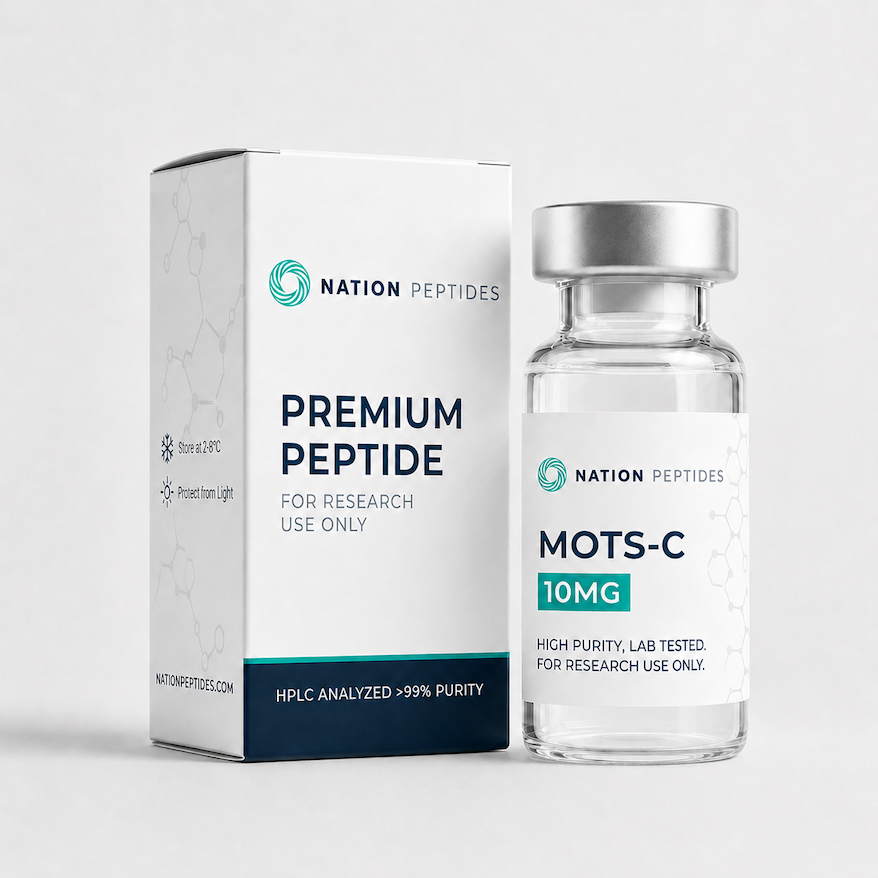
Looking for a reliable MOTS-c for sale listing? Nation Peptides offers MOTS-C in a 10mg lyophilized vial. It is a best seller in the Lifespan Extension category, and each vial is backed by a batch COA.
Key points:
- A single 10mg strength
- Listed with 99% verified purity
- In stock and ready for dispatch
- For laboratory and research use only
U.S. Manufacturing and Domestic Lyophilization
Nation Peptides manufactures domestically. There is no overseas sourcing, no dropshipping, and no middlemen. Compounds are lyophilized in the U.S., which means freeze-dried into a stable powder form.
Why that helps researchers:
- A shorter, more traceable supply path
- Consistent handling from synthesis to vial
- Clear accountability for every batch
Fast Dispatch and Tracked Delivery
Time matters in a working lab. Orders placed before the daily cutoff are dispatched the same day.
Delivery details:
- Warehouses in the United States, Europe, and Australia
- Tracked delivery in 2 to 3 days
- FedEx shipping with discreet packaging in the U.S. and Europe
- Each order ships from the closest domestic warehouse, so nothing crosses a border in transit
Guarantee and Support
Confidence comes from backup. Nation Peptides offers a 98%+ purity guarantee: send an independent test result, and the company will make it right. A 30 day money-back guarantee adds another layer of protection.
Storage and Reconstitution Basics
Even perfect material can be damaged by poor handling. These basics protect the integrity of your MOTS-c from the day it arrives.
Storing Lyophilized Vials
Keep the lyophilized vial in a freezer, away from light, until you are ready to use it. Cold, dark, and dry conditions slow down degradation.
Quick checklist:
- Store unopened vials in the freezer
- Keep them away from light
- Check the batch COA for lot-specific notes
Reconstitution Steps
Reconstitution means dissolving the freeze-dried powder in a sterile diluent. The method is gentle on purpose.
- Allow the vial to reach a stable handling temperature.
- Add your diluent slowly down the inside wall of the vial, not directly onto the powder.
- Swirl gently until the powder dissolves.
- Avoid shaking, which can damage the peptide structure.
- Refrigerate the reconstituted solution and reference the COA for stability notes.
The exact diluent volume depends on your protocol and the vial strength.
Supporting Research Supplies
Nation Peptides also carries research equipment that supports clean preparation and storage:
- The 10ml Reconstitution Vial, a bacteriostatic water diluent (0.9% benzyl alcohol)
- Travel Bags, insulated pouches for temperature-sensitive reagents in transit
Ordering these with your MOTS-C keeps everything for your protocol in one place.
From Order to Lab Door: How Nation Peptides Delivers
Knowing what happens after you click order removes guesswork. Nation Peptides follows a simple four step process.
- Order placed: Your order is confirmed instantly, and stock is reserved from a verified batch.
- Batch verified: The material is matched to its certificate of analysis before it is packed.
- Packed and dispatched: Orders ship the same day, in discreet packaging with no identifying markers.
- Delivered and tracked: Delivery takes 2 to 3 days from your local domestic warehouse.
This process matters for two reasons. First, matching each batch to its certificate before packing means the documentation you see is the documentation that ships. Second, local warehouses in the U.S., Europe, and Australia keep transit short.
Tips for a smooth delivery:
- Place orders before the daily cutoff for same day dispatch.
- Be ready to refrigerate or freeze vials on arrival.
- Check the batch label on the vial against your COA before use.
How to Choose a Reliable MOTS-c Source?
Search results for MOTS-c for sale can look identical at first glance. The differences show up in the details. Use this checklist before placing any order.
- Batch specific COA: Is the certificate matched to your lot number?
- Multiple tests: Does documentation cover purity, content, and endotoxin?
- Verification tools: Can you check the certificate independently?
- Manufacturing transparency: Is the material made domestically and handled in one chain?
- Shipping clarity: Are dispatch times and tracking stated plainly?
- A real guarantee: Is there a clear policy if purity falls short?
- Responsive support: Can you reach a real person with questions?
When researchers type MOTS-c buy into a search bar, they are really asking whether a supplier can prove what is in the vial. A source that answers every point above is worth shortlisting.
Common Misconceptions About MOTS-c
A few myths come up again and again. Clearing them up saves time and avoids weak study design.
- Myth: MOTS-c is only about energy. Reality: Research also covers stress response, gene regulation, and mitochondrial to nuclear communication.
- Myth: A label guarantees purity. Reality: Only a batch specific COA backed by testing confirms what is inside.
- Myth: All storage is the same. Reality: Lyophilized and reconstituted forms need different conditions.
- Myth: The science is settled. Reality: MOTS-c is a young research area, and mechanisms are still being refined.
The Road Ahead
MOTS-c research is still in its early chapters. Scientists continue to refine how the peptide interacts with AMPK, how it reaches the nucleus, and how its levels change with stress and age.
For laboratories, the path forward is practical. Start with verified material, document everything, and design experiments that can be repeated. Good science depends on good inputs, and that begins with a supplier that treats quality as standard.
Ready to Start Your MOTS-c Research?
If you are searching for MOTS-c with proof of quality, Nation Peptides is built for you. Every batch is triple-tested, every vial is backed by a COA, and every order is dispatched fast from a domestic warehouse.
Shop Nation Peptides now and find MOTS-C in the Lifespan Extension category. For laboratory and research use only.
FAQs
Q. Who is allowed to order from Nation Peptides?
A. Purchasers must be 21 or older and qualified researchers. A researcher verification step confirms this before you enter the site, and a Consent and Researcher Affidavit page is available.
Q. What does lyophilized mean?
A. It means freeze-dried. Water is removed under low temperature and pressure, leaving a stable powder that stores better than a liquid.
Q. Which payment methods are accepted?
A. Visa, Mastercard, Amex, and Apple Pay are accepted. Checkout is encrypted and SSL secured.
Q. Can Nation Peptides ship outside the U.S., EU, or Australia?
A. Those three regions have domestic warehouses. For other locations, contact the support team to learn what is possible.
Q. How long does a reconstituted vial stay stable?
A. Stability varies by compound. Most reconstituted research peptides hold up under refrigeration for a few weeks, and the batch COA notes any lot specific guidance.
Q. Where can I read the shipping and refund policies?
A. Both are linked in the site footer, along with the Terms of Service, Privacy Policy, Disclaimer, and Billing and Payment pages.

